What I Can Do For You As Your Digital Marketer

Winter quarter is coming to an end *sheds a single tear that is infused with joy and disappointment*. I will graduating in June with a degree in business administration with a concentration in marketing. These past four years have been a journey consisting of the typical peaks and valleys; with some slogging through mud in between them. I have confirmed that college is a great experience in that it really allowed me to figure out who I am and what career path I want to take. When I first entered into Western Washington University, I only had a vague idea of what I wanted to do. I knew that I wanted to go into business, and when family members, colleagues, and others would ask what I was pursuing, I would say something along the lines of, ” I know that I want to go into business but am unsure of what part of business to concentrate on.”

Then it dawned on me. I am MADE for marketing and I have been doing it since I was in 6th grade. For example, my brother and I were pretty bummed out that our middle school stopped selling candy, so we decided that we would take the opportunity to do what any marketer would do; fulfill the needs of customers. We purchased Skittles in bulk from the local Cash-n-Carry, and then we sold them for a dollar each. I remember getting a rush after each sale (it could have possibly been a sugar rush) although unfortunately we consumed most of our profits so it failed to become the candy empire I had envisioned.

Later on in high school, I started selling high-end clothing and Air Jordan’s through my website www.somefire.com, with the business model of buy-low and sell-high. This was very profitable until people realized that there was little barriers to entry. Soon I was surrounded by competitors from my school, so I decided to use my entrepreneurial spirit to go down a different lane. During my sophomore year of college, I created my own clothing brand called SomeFire, and stepped away from the (now saturated) luxury used clothing market that I had used to love. This custom clothing design experience strengthened my marketer’s mindset. So far I have designed (with the help of my good friend Bobby Davis) three different collections which range from t-shirts, long-sleeve t-shirts, tank-tops, and hoodies. I will be releasing my next collection within the next month.

IMG_6470

In January, I participated in the Student Marketing Associations XMC Case Competition with two other colleagues of mine. We met on a rainy Saturday morning at 8AM, we were given an Ivy business case and were asked to build a presentation, recommend what the business should do, and present it after 4 hours. We competed against 11 other teams, and placed first through an emphasis that I can only characterize as ‘unbounded creativity’ . Creativity is usually hindered when under-pressure, but we were able to work as a team to come up with a creative and realistic set of ideas to compete with an elite set of teams who we know would be going ‘by the book’ with their recommendations.

These past three months have been an excellent learning experience. I had the honor of taking a digital marketing class that expanded my digital marketing skills, and this single class has morphed me into a full-stack smarketer (smart-marketer). Within the last three months, I have become certified in Google Analytics, Hubspot Inbound Marketing, Hootsuite Social Media Management, and Google AdWords.

To obtain these certifications I needed to demonstrate to have an in depth knowledge on the topics. I have spent countless hours these past three months studying, blogging, reading, and learning about topics such as:

This quarter, hands-down, has been my best learning experience thus far in college. The list that you have just read (which include direct links to each topic that I blogged about) shows topics that we were assigned. With these topics, I was asked to not just read an article, but to know like it the back of my hand.

What I can do for you as your digital marketer? Well, a TON really. I am seeking a career in consulting, marketing, or as a marketing consultant and whichever of these directions I end up going, will bring digital marketing knowledge with me. I have gained a relatively vast base of knowledge when it comes to social media, content marketing, analytics, search engine marketing, and other digital marketing disciplines. I will also be participating in a project management crash course after this quarter which eventually will lead to a certification as a project management professional. I am an entrepreneur that loves solving problems, and coming up with great ideas. I have excellent communication skills, and I love working in teams. While being a full-time student at Western Washington University, I also engaged in internships and part-time work at companies such as Nordstroms, Hertz, and Bellingham Marine Industries. As your marketing consultant I will use the knowledge and skills that I have acquired over the past ten years to drive a positive impact for your company.

Throughout this quarter our class had to blog twice a week. Within the last three months, I have typed 22,473 words, and have had 475 views.
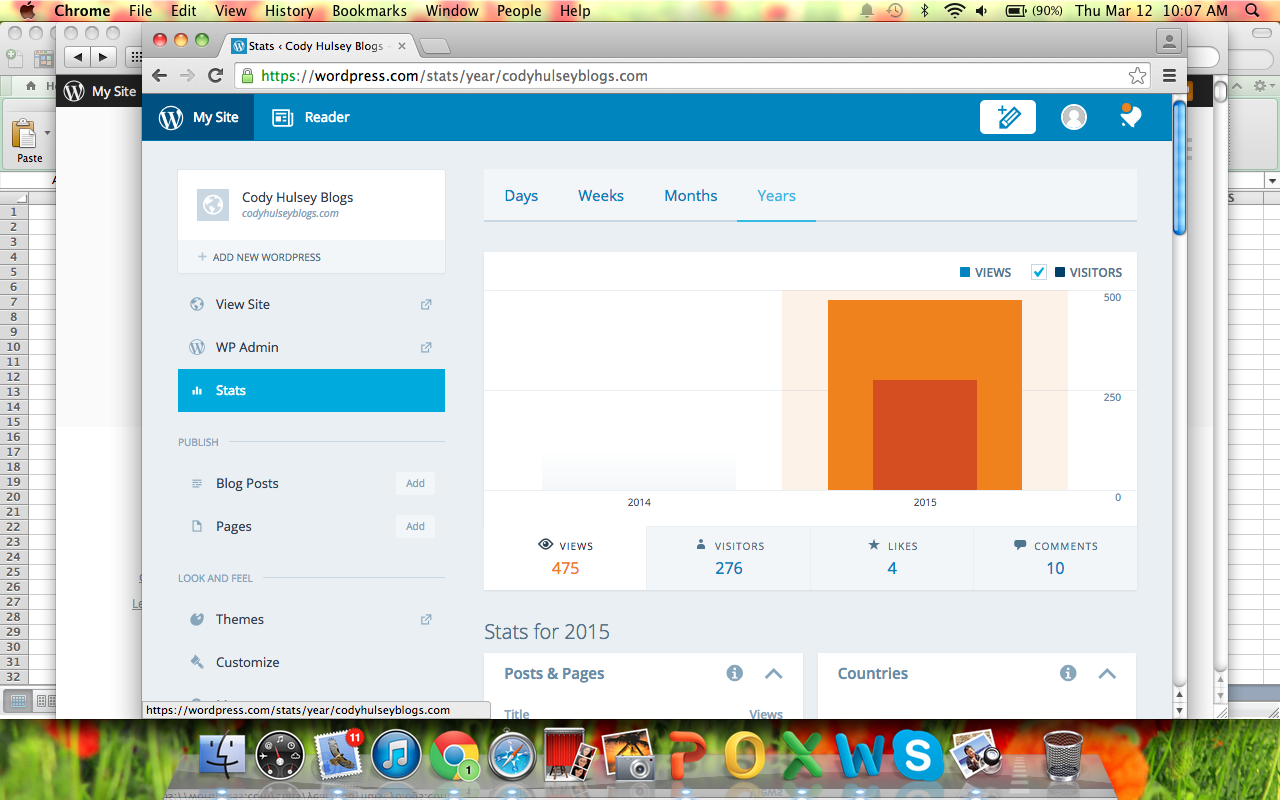
Screen shot 2015-03-12 at 10.07.51 AMI plan to continue to blog every week, but it could get tough when it starts to get nice out, and my final quarter at WWU starts. Until next time fellow smarketer…


What I Can Do For You As Your Digital Marketer

What’s The Point of Google Analytics?

Kid Cudi dropped a song a couple days ago titled, Love. It is actually a really great song, and I love it (see what I did there). This could be the first single off of his Man on The Moon III album, which is supposed to drop this year (Praying emoji). Give it a listen below. It is very uplifting, and makes you, well, happy.

https://soundcloud.com/cudderland/love

You might be thinking, “What does this have to do with Google Analytics, Cody Hulsey!?!?!”. Well fellow reader, I love the analytic’s side of digital marketing. Google is the big homie when it comes to analytics. They decided to go out of their way to create a certification course called Google Analytic IQ Certification. They also went out of their way to get you prepped for the certification by providing you with the Google Analytics Platform Principles. I am going to talk about a few of the most interesting things that I learned while watching the informational clips.

When you use Google Analytics you can collect and analyze data across a variety of devices and digital environments. Companies use Google Analytics to understand what their customers find and interact with when it comes to websites and mobile apps, but Analytics can be used to measure behavior on other devices like kiosks, point-of-sale systems, game consoles, and even appliance.

There are four components of the Google Analytics platform:

  1. Collection – this component is centered around the idea of collecting data, To successfully collect the data from your customers, you must paste the code on every page of your website that you would like to track.
  2. Configuration – you can configure Google Analytics to import data directly into your reports from other Google products, like Google AdWords, Google AdSense, and Google Webmaster Tools. You can also set filters that allow you to remove any data from your own employees (once a filter is set, you will not be able to see your employee’s data again).
  3. Processing – in this stage, Google Analytics transforms the raw data from collection using the settings in your Google Analytics account.
  4. Reporting – once Google Analytics is done processing, you can view the results of the findings on the reporting interface.

On the reporting page you will see that there is a data model. There are three components to the data model that are crucial to know about:

  • User:  a visitor to your website or app.
  • Session: the time they spend there.
  • Interaction: what they do while they’re on there.

I am going to paint a picture for you because I like coming up with stories. Also because people tend to retain knowledge and feel more connected when they hear a story.

Now close your eyes (not actually because you have to read this). Picture you are the owner of a small high-end fashion boutique. You have lot’s of customers, some who come in and look around at a particular pair of Raf Simons shoes, some that look at a Dries Van Noten Jacket, and some that purchase a Alexander Wang bomber jacket. You also have the customers that come in and ask if you have the most recent collection of the I Love Ugly S/S 15 menswear. When you tell them that you don’t carry that brand, they immediately leave. Think of each of those real life interactions in the same way when thinking about Analytics. You might have 5 interactions with a customer, or you might only have one (the I Love Ugly customer). Then however long a customer was in the store, is their session time.

So how does tracking work? 

Google Analytics uses tracking code to collect all of that precious data. The information that is collected, is shipped off to the Analytics servers via an image request. This image request is considered a “hit”, and it is the Maserati that speeds as fast as possible to Google Analytics.

Maserati

<!– Google Analytics –>

<script>

(function(i,s,o,g,r,a,m){i[GoogleAnalyticsObject]=r;i[r]=i[r]||function(){

(i[r].q=i[r].q||[]).push(arguments)},i[r].l=1*new Date();a=s.createElement(o),

m=s.getElementsByTagName(o)[0];a.async=1;a.src=g;m.parentNode.insertBefore(a,m)

})(window,document,script,//www.google-analytics.com/analytics.js,ga);

ga(create, UA-12345-6, auto);

ga(send, pageview);

</script>

<!– End Google Analytics →

In the above code you will see 10 characters that are bolded. This is the tracking code. A lot of websites will ask for you to paste the simplified tracking code and not the whole entire JavaScript text. Simply go into your Google Analytics settings to obtain this tracking code. There is different tracking codes out there. There is tracking code to create hits for websites and then there is tracking code for mobile apps.

Mobile apps don’t use traditional JavaScript code, they use SDKs (Software Development Kit). There are different SDKs out there, it all depends on the operating system i.e. iOS, Android, and etc. These mobile apps have a different way of dispatching as well. Data from mobile apps is not sent out immediately. Instead is stores the data, and then when there is connection to the internet, it’s sent over. SDKs dispatch hits every 30 minutes. So don’t freak out if it doesn’t look like your data is being recorded.

AmericanPsycho

I hope you have came to a better understanding on what Google Analytics is, and what you can do with it. Google Analytics allows you to understand the actions of your customer whether they are on a website, mobile app, kiosk, appliance, or much more. When you realize customers are not viewing certain pages, you can use your creative skills to direct them to that neglected page, possibly with A/B testing? Until next time fellow smarketer…

DogWind

What’s The Point of Google Analytics?

Is Mobile Marketing Really Going to Last?

Isn’t it the worst when you are linked to a website, or you go to visit a website that you looked up through some sort of search engine, and then when you get there, it sucks. When I say it sucks, I am talking about when you can’t press on links, maybe you have to scroll to right or left to see what an image is, or the text is tiny. All in all, it sucks, its frustrating, and it makes you think poorly of that business. Like, why have they not gotten with the times and created a website that is mobile-device friendly?

If you are still confused on what I am talking about. Well, view the photo below.

The photo on the left is what you would ideally see on a regular desktop computer, but it is just plain annoying when you have to view it through a cellphone. You want your website to be mobile-device friendly, like the one on the right.

Those informative folks over at ComScore have created a beautiful white paper titled, U.S. Digital Future in Focus 2014. I would be lying if I said that this white paper was useless, because it is damn informative and eye-opening. Multi-platform users (people who use both mobile and desktop devices) are becoming more and more popular. Did you know that at the end of 2013 56% of digital media consumers constituted the ‘multi-platfom majority’? Yeah, I didn’t know that either.

Thinking

Since this is becoming more and more prominent, marketers need to tighten their boots and jump feet first into being able to market to multi-platform users. In all actuality, Instead of surfing the wave, you will become the wave. You will be able to tell your competitors that you been on that mobile marketing tip.

You have to be able to tailor each message depending on if they are on a mobile device, or on their desktop. This partially goes back to what I was talking about in the beginning of this blog post. Based on what they are doing on their mobile device, you can target certain advertisements, certain offers, and much more. As a marketer, you must get as creative as possible.

In December of 2010, smartphone engagement has grown from 131 billion total minutes spent on the platform to 442 billion by December 2013. Mobile accounts for 57% of all internet use. Smartphones have passed desktop usage. That’s insane, technology is changing too fast man. ***MIND BLOWN*** Now do you believe that mobile marketing is only going to become more and more popular?

In 2013, 85% of internet time spent on smartphones involved apps. People love their apps. Marketers should be aware of this (hopefully they already are tbh) because it could be a great way for them to enter into markets that is not typically the norm.

Starbucks is the king when it comes to getting you addicted to their products. Starbucks recently created an app that allows you to make purchases through your phone. Washington Post actually wrote an article titled, Starbucks Has Managed to Get You Addicted to Its Coffee – And Its App. Starbucks announced that customers pay for a purchase using a smartphone up to 7 million times per week. Out of all the transactions that Starbucks accumulates, 16% of those are mobile payments.

Starbucks

Starbucks is killin’ it right now. They have also implemented their My Starbucks Rewards program, which allows their members to earn special discounts and free shwag. They also give you a free coffee when it’s your birthday. Except they’re sometimes a couple weeks off (this happened to my digital marketing professor), better late than never, right?

Another cool thing is that they are able to decrease the amount of credit card transaction which means less credit card fees on their end. Starbucks is about to make a killing. BRB about to go invest in Starbucks stocks. Fun fact, since December 23rd their stocks have jumped up ~$12. Not too shabby Starbucks, not too shabby.

Starbucks is ambitious which is probably a huge component of their success.In 2015, they plan on allowing you to place orders from your phone. This will decrease wait times, and potentially raise sales. BRB about to actually go invest in their stocks.

ComScore created ANOTHER dope white paper titled, The U.S. Mobile App Report. Let’s say that every 8 minutes that you are on your cellphone, 7 of those minutes involve an app. People love their apps. If businesses really want to connect with their target audience, they should create an app they can view their website, products, or offers. I frequently view Four-Pins.com, which is IMO one of the dopest fashion, life, style, gear blogs on the internet. Like check out this recent post by them. Do you love Raf, but hate the price? Because I do. I would purchase tons of Raf Simons if I could afford it. When I land my first job, you better believe that I am going to be Raf’d out (hopefully, student loans could prevent that for awhile). If they had an app, they could potentially get a lot more views/ viewers. It’s always so much easier pulling up an app, than having to go through a search engine to go to a website. (wow, technology has made me sound very lazy -___- ) Creating an app could take some foot-work on their end, but I think they would benefit greatly.


Damn, if that’s not #fire, IDK what is. Look at that fish-tail. Look at that attention to detail. #Wheww #Wheww #Wheww.

So let’s say that you are reading this blog post because you want to improve you site. Well, Moz created an article titled, The SEO’s Guide to Building a Great Mobile Site. When you are trying to decide on how to make your site, mobile-friendly, you need to think about the content. There is two options for content, you either have the same content that is on your site, or different content. Before you worry about the technology aspect, you need to understand what you goals are with the mobile site. Do you want to simply inform them about directions to your restaurant? Possibly only list your hours? Maybe all the information that your regular site provides is a little excessive and needs to be trimmed down. This step may seem miniscule, but it is a huge component.

Once you have decided the content-side of the mobile website, you can dig into the technology side. The easiest way and most time efficient option in the long-run would be to create a responsive site. This is an identical site, but it works better with mobile devices.

Mobile search is the future. It has surpassed desktop search, and is going to continue to place desktop’s in the future. At this rate, desktop’s will probably not even exist in 10 years (actually I bet you $100 there will be some type of projection that comes off your mobile device, and whenever you need to see something bigger, or work on something, you simply project it onto your wall. IDK just thinking out loud). Until next time fellow smarketer…

JAY

“Blog so hard, got a broke clock, rolleys that don’t tick-tock” – Jay-Z (pretty sure he said that once, could be wrong.)

Is Mobile Marketing Really Going to Last?

Programmatic & Native Ad’s… That’s a Mouthful.

Programmatic. What a word. Programmatic is one of those of those words you drop around your friends to impress them. But you have to make sure that you use it in the right context. You never want to use big words in the wrong way, it just makes you look unintelligent. Programmatic means (according to Google) of the nature of or according to a program, schedule, or method.

Back in the olden days, when people had to walk barefoot 5 miles to school in the snow, there was no programmatic ad buying. Every  time someone wanted to purchase an ad online, they had to deal with manual RFP’s, negotiation orders, and insertion orders to purchase digital media. Nowadays, you can purchase ads over the computer, instead of in person (it is a little more complex than that, but that will suffice for now). Check out the video below, where they discuss programmatic ad buying like you are 8-years old.

http://c.brightcove.com/services/viewer/federated_f9?isVid=1&isUI=1

I recently read an interesting blog post from Forrester.com about programmatic ad buying. Joyce believes that major brands and massive holding companies budgets will increase within the next couple of years. Programmatic ad buying is going to be a larger portion of these companies marketing budgets. Proctor & Gamble is seeking to by 70% to 75% of digital ads programmatically by the end of the year. WHAT!!! Leave some for the little guys, jeeze.

Joyce also believe that programmatic ad buying is going to become present in video and TV. These ad sellers are noticing that programmatic is becoming a huge part of these companies marketing budgets. They want a piece of this pie, and they are currently pre-heating the oven to 350 degrees Fahrenheit.

BakingAPie

Joyce states that their is going to be a stronger emphasis on individual-based targeting is where the advertising industry is headed. Facebook has had great success with this since their release of Atlas. Advertisers want to be able to effectively advertise over cross-device platforms. The ability to tie devices online and offline will change the media channel game forever.

Programmatic ad buying can be a complex subject. Like the name “programmatic” makes me think of problematic, which makes me think that its going to be a problem to learn, but in actuality, it is a problem, a problem in the sense of being good (hopefully I didn’t lose you there). Programmatic is the new bad boy in the digital marketing world. Yeah, that programmatic below.

BadBoyThe guys and girls over at AdWeek, are a bunch of great guys and girls because they care about how intellectual you are. They want to see you succeed and become the greatest digital marketer to ever touch a keyboard. They created an article titled, Programmatic For Dummies. In this article they talk about programmatic ad buying, the importance of it, where it is headed, and much more.

“Programmatic is a catchall term that many people are using to categorize everything from behavioral and intent-based targeting to real-time bidding and exchange-based buying of inventory” – Peter Nayor, Former EVP at NBCUniversal. Real-time bidding and exchange-based buying of inventory are two big components when it comes to programmatic ad buying. Real-time bidding (RTB) is not the same as programmatic. The main difference is value. Programmatic is about using data, tech, and software for getting more for every dollar spent. This is what really gets the client happy. Think of programmatic as the NY Stock exchange. It contains the same elements, just different names.

Automation is one aspect that of programmatic ad buying that really helps it excel. But the next step is improving the advertisements. You want to be able to sell a pair of Common Projects men’s shoes to someone who love high-end fashion, not someone who faint when they saw the price tag.

FaintingI believe that I am very creative. AdWeek had a section called, How does creativity fit into this world?, and it really shouted at me. Creativity is still going to present when it comes to programmatic ad buying. Even though Google is known for being algorithm-ruled, they are pushing for programmatic creativity. The umbrella initiative that they have created is called, Art, Copy, & Code. That name just seems very Google-esque.

Another topic that I believe is worth talking about is native advertising. There is a fantastic podcast called, StartUp, where one man by the name of Alex Blumberg documents his experience starting his first, well, Startup. Blumberg uses a different type of advertising called native advertising. In typical advertising, the host would stop talking, and then the recorded advertisement would take over. But with native advertising, the host intertwines the advertisement into his talk. They make it almost seem like they are doing it for free. Which can get a lot of backlash. They got in trouble for interviewing a kid about his website, and they didn’t clarify that they were going to use it in the advertisement, and people freaked out on twitter because they it was misleading and they couldn’t tell if it was content or an advertisement. Except Blumberg gets paid by MailChimp $6,000 per episode. That is nuts!!! It makes me wonder what the customer acquisition costs are like for MailChimp. I didn’t know MailChimp had it like that.

Anyways, native advertising is a new form of advertising that I am sure you will notice more often. I listen to another podcast called, Brilliant Idiots. It is quite hilarious, and they actually participate in native advertising. They are sponsored by a product called, NatureBox. They integrate it ever so smoothly, and simply have a conversation about it. They crack jokes, they tell stories about it, and it makes you want to go out and buy a box of peanut butter nom-nom’s. But I could see their being controversy since the way they integrate it into their show it also makes it seem like content.

Digital marketing is changing so fast fam. If you are trying to keep up with the times, make sure to follow this blog, or check it every Tuesday and Thursday. Until next time fellow smarketer…

WavingBye

Programmatic & Native Ad’s… That’s a Mouthful.

Do You Even Code, Bro?

Disclaimer: Coding is not the substance that rappers often talk about consuming with sprite and jolly ranchers. Coding is the process of assigning a code to something for the purposes of classification or identification. Two hours ago my coding skills were pretty sub-par. I have dipped my toes into it while taking MIS classes at Western Washington University. It is one thing that has always fascinated me. You have the ability to create a web-page by typing in letters, numbers, and symbols behind the scenes (HTML) to create something beautiful. I feel like you automatically impress people when you say that you can code. The response is always like, “wow! That’s impressive!”, or “wow, you must be hella smart”.

Learning how to code is like learning how to speak another language. There are all these different terms like, href  and colspan, like what in the world does that mean? Href sounds like a noise someone would make when they are out of breath. Href actually means hypertext reference, according to Ryan Tomayko. Yeah, mind blown.

MindBlownNeo

Coding is an extremely good skill to have when you are trying to become the Steve Jobs (RIP) of digital marketing. Tech Cocktail wrote an interesting article talking about why coding is such a powerful skill to have when you are a marketer. We have discussed SEO in the past, and I have stressed the importance of it. One way to really use SEO in a beneficial way is to be able to read HTML text. As discussed in past posts, the Google spiders crawl through the internet and they scan HTML text. They are not able to read java script, they can’t watch your cat video, they read HTML. If you are able to code (write HTML) then you can read it too. You will be able to fix flaws, change keywords, and maximize exposure.

I am sure your Mother has told you to never judge a book by its cover. When it comes to a web page, judge a book by its cover. No one is going to take you, or your business seriously if you have an atrocious web page. If you are able to code, then you are able to learn how to create beautiful web pages from the bottom up *Drake’s Started From The Bottom song starts to play*. Side note: have you listened to Drake’s new mix-tape If You Are Reading This Its Too Late? If not, go give it a listen, but first finish reading this blog post because this is going to be the most valuable content that you read all day/ night.

StartedFromTheBottom

We have discussed email marketing and how it is dead NOT DEAD. There are great services out there like MailChimp that allow you to create e-Newsletters, and “Send Better Email”. But if you want to really excel when it comes to email marketing, learn how to code. I have used MailChimp multiple times in the past, and those templates don’t always work how you want them too. When this happens, your coding skills come in for the rescue like SuperMan. Think about this… if you have a better email campaign… maybe it is compatible on multiple platforms (web, mobile, etc.)… and streamline… you may very well experience more opens, clicks, and higher conversions. This isn’t rocket science, my friend.

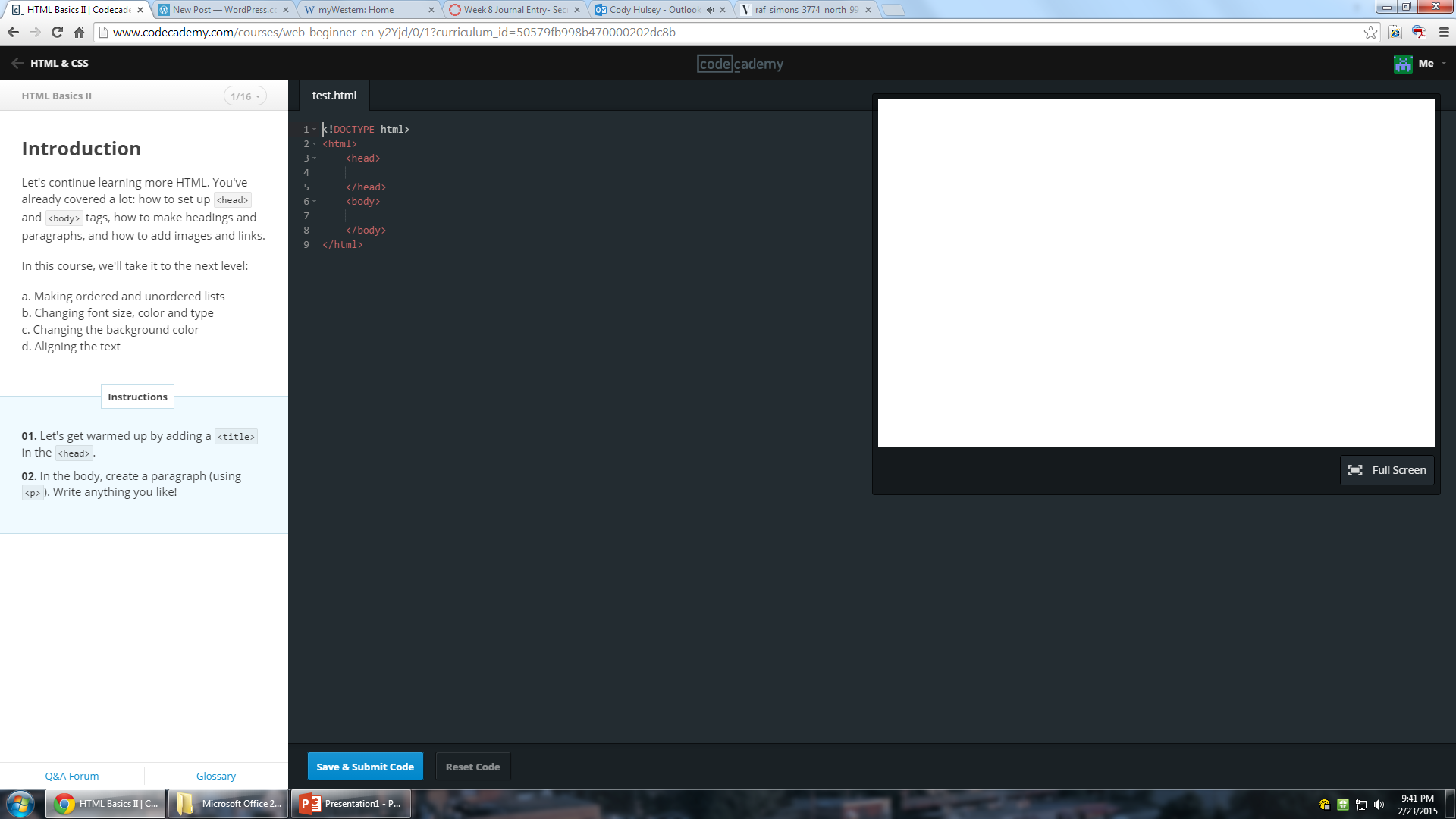
Today I went to website by the name of Codecademy. Codecademy is an awesome website that teaches you how to code. I sat down for over 2-hours, and was able to complete 4.5 lessons, which is 33% of the class *Pats myself on the back*. Since I am proud of myself, I am going to list what I learned:

  1. HTML Basics
  2. How to Build Your Own Webpage
  3. HTML Basics II
  4. Social Networking Profile
  5. & 53% of HTML Basics III

BEFORE

TheFirstHour

AFTER

2HoursLater

I know that I am not a coding expert but when I get this blog off, I am headed right back to Codecademy to finish up what I started. Can you say, “Resume building opportunity!!!”.

Codecademy is very beneficial though. I would recommend it to anyone looking to learn how to code, or sharpen their already coding skills. Go Code or Go Home!!!

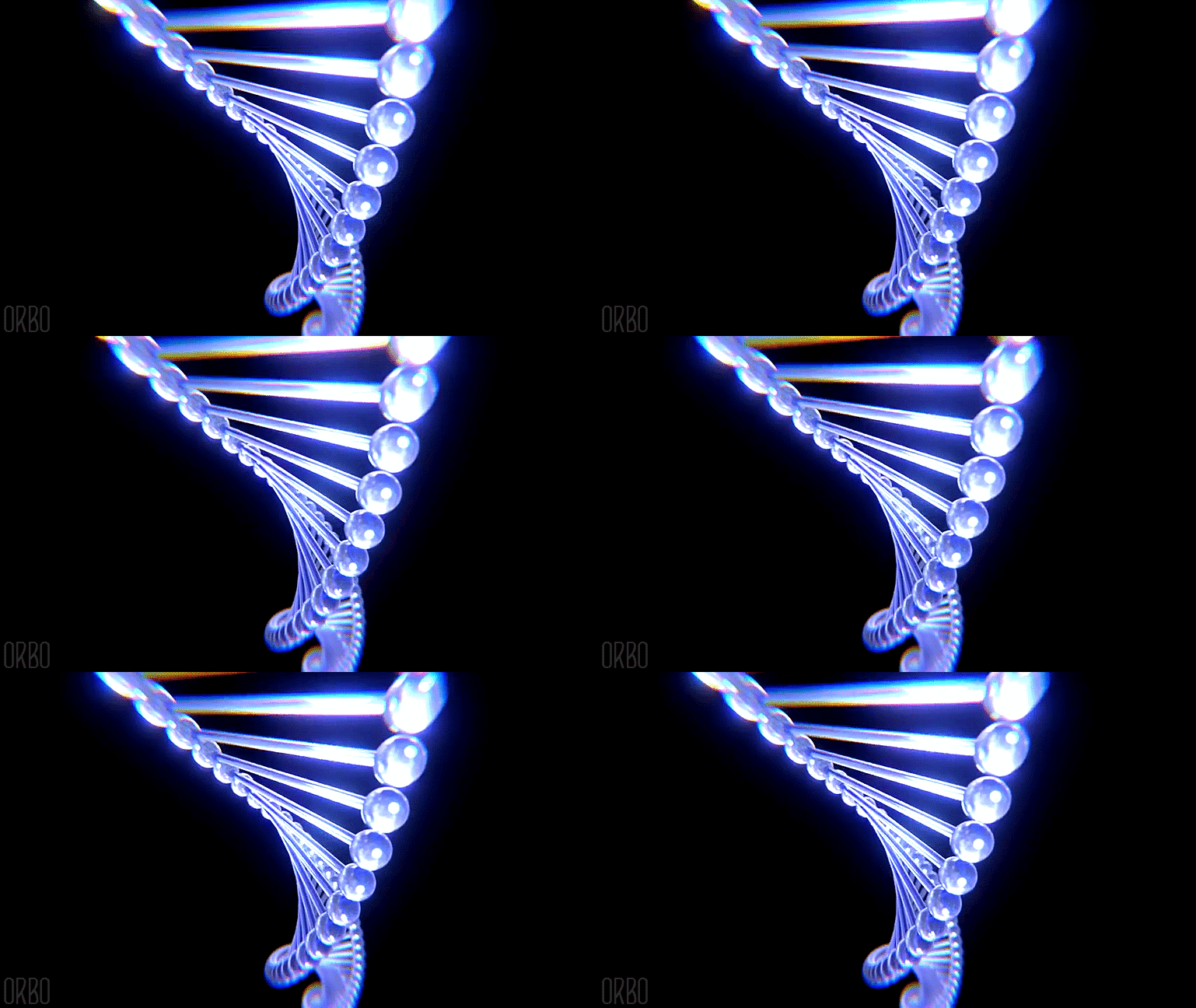
Since wanting to expand my knowledge on coding, and make myself seem more reputable as a fellow digital marketing blogger, I read a write-up title, Moore’s Law Is about to Get Weird. I know, with a title like that, you HAVE to find out why its going to get weird. Speaking of weird, Wetware computing was brought up (the only thing slightly weird is the name). Wetware computing is using the concept of neurons and DNA. Cells can be thought as a type of computer, DNA provides information storage, RNA represents input, ribosomes do processing, and proteins form the output. Now imagine taking this concept, and applying it to computers *MIND BLOWN*. Wetware computing can revolutionize the security of people’s credit cards. William Ditto came up with the idea of Chaologix. Ditto has developed a neuron-inspired, chaos-based chip for applications that require a high level of security. Traditional chips embedded in credit cards generate electromagnetic fields and consume power in ways that can make it easy for hackers to steal your information. Chaologix makes it WAY harder, and more secure. Another way they could implement it is through drivers licenses. Last time I went into the DOL they told me to keep my driver’s license in a special sleeve, or else hackers will steal your information. First and foremost, there is no-way I am keeping my driver’s license in a sleeve. That is ridiculous, and like way too inconvenient. Who do they think they are??? Ditto could come through and implement Chaologix into drivers licenses so that everyone’s information is safe.

DNA

Chemical Computing was another interesting concept that was brought up in the article. A chemical reaction has inputs (reactants) and outputs (products), and processing happens during the reaction itself. While you may be thinking a lot of reactions are only one direction, which would limit their potential as computers!!! Think again Buddy, a bunch of smart Russian scientists discovered between the years of 1950-1960 a class of chemical reactions called, “BZ reactions”, that move back and forth in time. Chemical computing is used in exploring a large set of possibilities all at once. An example would be finding the shortest route in a maze or city. Chemical computing is still being explored and process improvement is something that is at the top of the list. With that said, it’s pretty slow when it comes to computing but it is getting faster.

You have all heard the term “coding” thrown around, but have you really caught it? I dare you to sit down in front of you computer, laptop, tablet, or cellphone (might be kind of hard tbh), and take a course through Codecademy. You will learn a TON and be able to brag to your friends that you know the fundamentals of coding. Until next time fellow smarketer…

SeeYou

Do You Even Code, Bro?

Does Search Engine Marketing Work? Duh

So let’s say you are looking for a new pair of Common Projects Achilles because your old ones are turning into the definitions of “beater’s” (which I personally think adds a lot of character and tends to look cooler than brand-new shoes). You pull up your browser using Firefox because Internet Explorer is a joke, and you type into your browser Google.com. Google pops up and you type into the search bar “Common Projects Achillies Low Men’s Shoes”. BOOM after 0.41 seconds, 81,900 results pop up. Then you notice that the first two links have this icon next to the title that reads “ad”. Like what is that fam? Is that a real link? Is it spam? Am I going to get hacked by an anti-virus system which is actually a virus system posing as Norton anti-virus? Don’t worry fam, I got the answers to all of these questions.

SponsoredCommonProjects

This is what scholarly people call paid search AKA PPC AKA search engine marketing. I felt like a rapper when I typed that out. You know how a lot of rapper’s say things like, “Yo it’s A$AP Rocky aka that pretty flacko aka that PMF aka Lord Pretty Flacko Jodye The II” (Quoting the famous A$AP Rocky). Anyways, search engine marketing is an awesome service for companies looking to build awareness around their products or services. Before we talk about Google AdWords more in depth, I want to discuss some key building blocks that I have personally learned about from a nifty eBinder (which I believe is a pretty good term considering its over 350 pages long) created by Google.

  1. Keywords: You determine what keywords trigger your ad to appear. These would be words or phrases like my example of “Common Projects Low Achilles Men’s Shoes”, your ad would pop up.
  2. Placements: When you create an ad or campaign you have the choice of where you would like you ad to be placed. This is critical because you wouldn’t ideally want to have your ad on the side of the NYTimes.com if you are selling a luxurious pair of shoes. You can also allow Google to choose where they believe the ad should be posted based on the keywords that are used.
  3. Ad Ranks: Now let’s say that you are Tres Bien (High-end fashion company) and your competitor Mr. Porter (Another high-end fashion company) is selling the exact same shoes. Now let’s say that you both want your ad to pop up when someone types in “Common Projects Low Achilles Low Men’s Shoes”. This is where Ad Ranks comes into play. Ad Rank is a combination of your bid (how much you are willing to pay) as well as your Quality Score (measurement of the quality of your ads, keywords, and website).

Above I mentioned Bid’s and Quality Score, which I want to discuss a little more. When you do a keyword-targeted ad on Google and it’s search partners, your bid would be your maximum cost-per-click bid (this would be the maximum amount of money you are wiling to pay every time someone clicks on your ad). The Quality Score is a mixture of your keyword relevance, the quality of your landing page, your ad’s click-through rate (CTR), adjusted for its position on the page, and a few other factors. This is the present, and the future of marketing. As mentioned in my blog post about search engine optimization. A tremendous amount of people use search engine’s on a daily basis. In fact, Google actually has a counter and when I checked it at 9PM, they had well over 3 million searches just in that day alone. This is nuts!!! Think about how many potential customers you can get strictly off of search engine marketing. After using search engine marketing you will have way too much revenue, and your profit margins will be twice your age. Before you know it you will be throwing money in the air because you forgot your sunscreen, and you need shade. ObamaCreatingShadeHubspot also created an eBook titled, The Beginner’s Guide to Paid Search. This eBook goes more into depth on the benefits of paid search and how you can truly use it to your advantage. One thing that they discussed was the difference between paid search and organic search. These are important concepts to know, especially since you are considering dabbling in paid search.

  • Organic search: these type of search queries are based on unpaid, natural rankings determined by search engine algorithms, and can be optimized with various SEO practices.
  • Paid search: well this would be paid search, of course. When you pay that fee, it allows your site or ad to pop up when someone types in a phrase that correlates with the phrase that you “bid” on.

Hubspot also mentions that 70% of people press on the organic links, and the remaining 30% of people press the paid links. So you can’t expect insane ROI right off the bat. Think about it though, you are exposing yourself (wow, there man) to people that would have potentially never thought of your website. They might not press the link right at that moment, but next time they see your site, it will trigger curiosity in their brain. Before reading this blog post you probably thought that getting to the top of Google or any other blog post was impossible. Well now you know the impossible is actually possible. Thanks to search engine marketing. THINK AGAIN SEAN BEAN!!! Search Engine Marketing as stated before, is the present, and the future of marketing. Whether you are a small scale business that is trying to build awareness, or an enterprise-level business that is trying to build market share. Search engine marketing is the key to the door that leads to success. Until next time fellow smarketer… //

Does Search Engine Marketing Work? Duh

When You Use Socedo, The World Is Yours

The world is yours. Isn’t that a great line? That line resonated with me when I first heard it rapped over a NY-style beat in 8th grade. In this song, destined to become the seventh best rap song of all time, Nas gives tribute to the famous movie Scarface played by Al Pacino. But that is not why the song resonated with me; what stood out to me was a single line in the lyrics, “The world is yours.” This single line is still one of the most truthful and powerful statements I have ever heard. When you have the mentality that you can take on the world, and essentially own it, you cannot be stopped.

When you use a platform like Socedo, it truly does seem as if the world is yours. Socedo allows you to find new prospects and qualify them automatically by leveraging existing social media profiles. Big companies are not the only ones that can use this clever service. Think of all the authors, musicians, or even just regular people who want to promote their personal brands. Let’s take a look at one specific scenario showing how authors and musicians can utilize this platform to achieve professional success and obtain warm sales leads.

My grandfather is an author and he has written three novels in the past. Recently he signed a deal with a publisher for three more novels and they asked him to get on social-media. Since he has no social presence whatsoever, he approached me and asked me to help him with his social-media strategy. Since I am certified in Hootsuite social-media management and passionate about marketing, he thought that I would be a great candidate for the job. Naturally, I accepted his offer and for the past month have been brainstorming ways to promote his new book and generate leads when it is released. I felt like I had some good ideas, until they were all trumped when I met Aseem Badshah, the CEO of Socedo, for a digital marketing lesson on Google Hangouts. Thanks to that conversation, it dawned on me that I could save a ton of time and generate a ton of leads and product awareness by using Socedo.

One benefit of Socedo is that you can figure out who your true target audience is, where they are having conversations, and how to use the right language to really engage with them. When it gets closer to the release of my grandfather’s book, I am going to use Socedo to engage with people who are mentioning books, war novels, spy novels, and Tom Clancy on Twitter or LinkedIn. I will then look for keywords in their profiles along the lines of novelist, book-lover, avid reader, reader, and much more. This portion could be tricky and I will have to perform some A/B testing to figure out the right key words to target. When formatting Socedo’s Direct Message Template I will be sure to come off as transparent as possible. I want this portion of the Socedo journey to seem like a real interaction that intrigues my new warm lead. I will say something along the lines of, “Hi [First_name], I saw that you are a fan of #TomClancy. You should check out Jeff Layton’s new novel #YouWontBeAbleToPutItDown – [Insert hyperlink here]”. This direct message is going to cause curiosity among the warm lead and potentially will lead to a conversion. After briefly playing with these tools, I’ve become a big fan. I’m convinced that when you use Socedo, the world is yours.


Setting aside businesses and authors, when musicians figure out the value of Socedo, they will not be handing out mix-tapes on the corner of 5th and Pine (Downtown Seattle reference). As a musician I’ll use Socedo to promote my past music, upcoming shows, and future music. One way to do this is by setting your conversation keywords to something along the lines of #SeattleMusic, #UpcomingArtists, #KanyeWest, and “I need new music” (people are tweeting this on Twitter). Then I will look for Bio Keywords that consist of ‘Music’, ‘I Love Music’, ‘Record Label’, and ‘Music Producer’. Being based out of Seattle, I would use location keywords for Washington to build awareness inside my state of residence. For the Socedo Direct Message Template I would create something along the lines of, “Hey [First_Name], I saw that you like #KanyeWest. I think that you would love my newest mixtape. Here is a free download – [Insert hyperlink here].. Due to personalization, I guarantee this will generate a ton of warm leads, build awareness around a personal brand, as well as start conversions (and mix-tape downloads). When you use Socedo, the world is yours.
Socedo offers a service that lets you get creative in the way you generate leads. If you are an author or musician viewing this post, I truly hope that you are feeling inspired to take on the world. Hopefully you are discerning new ways to beat your competition with creativity and the latest set of tools. Most importantly, I hope you have that feeling like that you cannot be stopped. The world is yours.

TheWorldIsYours

//

When You Use Socedo, The World Is Yours

Search Engine Optimization Builds Foundation

Picture yourself crawling through the Amazon looking for your next meal. You are stepping over fallen trees, leaping over small puddles, and the air is thick and humid. Your body has been sweating since the sun came up and it feels like you have an extra layer of skin because you are covered in a coat of mud. You are holding your spear above you right shoulder, looking around, taking in everything. Every branch that snaps causes your head to quickly inspect the vicinity in hope that it could be something to bring back to your family. You hear the echo of a howler monkey howling in the distance. You all of a sudden see something from a far which looks like a Tapir. You quietly get closer to it, trying everything possible to not scare the tapir off. You get within a good distance and dial in. You pull back the spear, and are just about to fling it as hard as you can. Your heart is pounding, your starting to feel a rush of adrenaline. You squint your eyes and tighten your grip on the spear. You take a deep breath and let it out slowly. You breathe once more, but when your lungs are filled up, you launch the spear at the tapir. The spear makes perfect contact and the tapir collapses. You feel an instant feeling of relief because you can finally feed your family that hasn’t been able to have a real meal for the past three days.

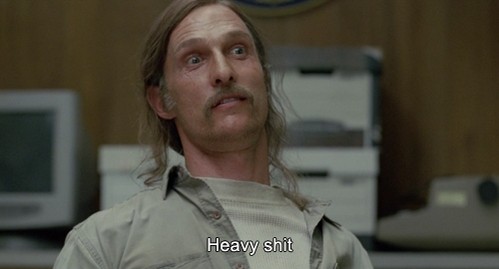
Damn, heavy shit.

You might be thinking, “What could this possibly have to do with search engine optimization?”. Well, picture the tapir as SEO (search engine optimization). The tapir represents the dinner or the goal that you hope to accomplish. SEO is the goal that you hope to accomplish and when you have mastered it, it will lead to higher traffic, which then will lead to more leads, which then will lead to more conversions, which will then lead to money in the bank. So sit tight. Sharpen your spear (or pencil) because I am going to teach you how to kill (in the sense of making a markedly favorable impression) SEO.

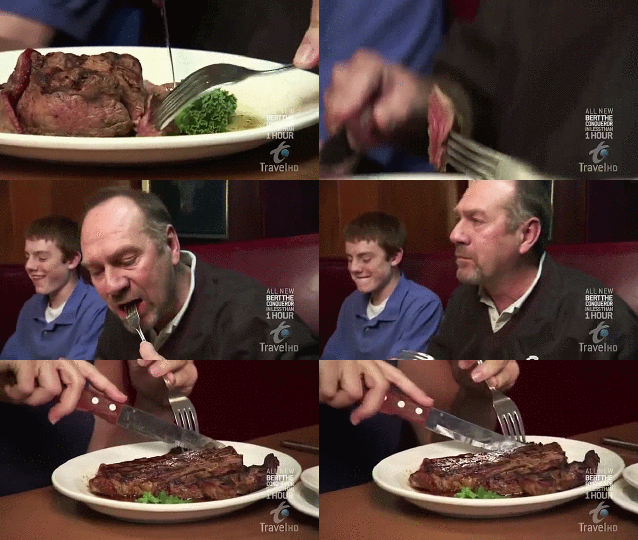
So what in god’s green earth is SEO? SEO is the practice of improving and promoting a website to increase traffic from search engines. Search engines are brilliant. But they are not that brilliant. You have to spoon feed them. In the past I have blogged about this, and talked about how you can’t put a steak in front of a 2 year-old and expect them to cut it up, and then eat it. You have to cut it up for them into pieces that they can consume. The same can be said about search engines, they need their information cut-up for them. Search engines have two major functions: crawling and building an index, and providing search users with a ranked list of the websites they’ve determined are the most relevant.

SteakGettingCutUpMoz created a beautiful eBook on Search Engine Optimization. The eBook is packed with information pertaining to how search engines operate, how people interact with search engines, keyword usage, and much much much more. Moz is really strutting their stuff when it comes to SEO, they got it down to the T. Since their eBook is quite hefty, I am going to talk about some of the key principles of SEO.

Search Engine Optimization matters. Like really, really, really matters. In 2011, ComScore conducted a study on search engines and found that Americans conducted 20.3 billion searches in one month. WHAT? Those searchers are trying to find website’s like yours, and if they are not successful, they are going to your competitors.

To perform healthy, wholesome, GMO-free search engine optimization, you want to make sure you do a number of things. One of those being indexable content. To perform fantastically in search engine listings, your most important content should be in HTML text format. Crawlers are not able to identify images, flash files, and java applets. So for images, provide alt text. For flash and java plug-ins, add text on the page. If you do not provide text for the crawler to scan, they will get to your page, and all of your valuable information will be invisible. You can also provide a transcript from the videos you have on your site since crawlers will not be able to press play and take notes on your video.

If you feel like you are not the best at indexable content, then you can use a variety of tools to make sure that your content is able to be read by search engines. One of the most popular tools is Google Cache. This tool allows you to see what elements are visible, and what elements are invisible.

Beware: you may be shocked to see that your content is invisible to search engines.

ShockedAnother important aspect of SEO is keyword usage and targeting. A big portion of SEO is keywords. But a lot of people thought that you could just put a bunch of keywords at the bottom of a post, or in the middle of a post to get high search rankings (they call this “stuffing”). Bing, Google, and Yahoo! caught onto this and made it so that they can detect when you perform this Tom Foolery, and if they do catch you they will lower your site ranking, and sometimes not even show your site. One of the best ways to optimize a page’s rankings is to ensure that they keywords you want to rank for are prominently used in titles, text, and metadata.

When you make your keywords more specific, you narrow the competition for search results, and improve your chances of achieving a higher ranking. For example, If you were selling a men’s Helmut Lang jacket and someone typed into Google, “men’s coat”, there is a high probability that it wont be seen. But say that same searcher types in, “Helmut Lang jacket men’s” there is higher chance that your site will be ranked higher and be seen.

InterestedMoz also created an awesome eBook called The Beginner’s Guide to Link Building. The concept of link building is basically having other websites include hyperlinks back to your website. The search engines are crawling through millions of sites and the more websites that give credit, or link back to your site, shows that you are a credible site. There are different ways to get websites to post hyperlinks back to your site. One way to do this is by connecting with industry colleagues. You can have them post “badges” on their site that say something along the lines of, “Check out our industry partners”. Another way is to produce GREAT content. By creating original, organic, home-grown valuable content you are increasing your chances of people sharing your content, quoting your content, and/ or using your content in their blog posts. This shows that you created this content are a valuable asset in the industry.

Moz brought up a lot of great ideas on how to perform effect link building. But one idea that they suggested that really stuck with me was the idea of guest blogging. This concept is great because it brings traffic to your site, as well as, tells the search engines that you are a credible site. Especially if you are able to get someone influential (look up their Klout score via Hootsuite!) to blog. That influential person will mention on their site that they did a guest blog post on your site, and by doing that it will send their traffic your way.

Search engine optimization really matters, it is not just a fad. In this blog post I have talked about some of the principles of search engine optimization and link building. I strongly encourage you to check out the eBook’s that I have referenced, especially if you want to become an SEO pro. Until next time my fellow smarketer…

RonPaulWaving


//

Search Engine Optimization Builds Foundation

Email Marketing is Not Dead… Just Think Outside the Inbox.

When I wake up in the morning, I get out of bed, walk over to my Windows Phone, and turn off my alarm. Prior to turning off my phone I quickly skim through my emails that I have accumulated since I went to bed. 9 times out of 10 these emails are “spam”. The only thing that I read from these emails is the headline. I don’t even open them. I am not engaging with this email whatsoever.

NOPE

I have participated in email marketing while interning at Bellingham Marine. We would use a service called MailChimp, where they coined the term “Send Better Email”. Which is just that. They allow you to send better email. MailChimp allows you to customize emails using templates. They also offer tips on what to do regarding wording of headlines, when to send out an email to get the most exposure, and much more.

A popular podcast by the name of “StartUp” (which I am halfway through) advertises MailChimp throughout their podcast series. I would highly recommend checking out MailChimp and the podcast “StartUp”. Maybe even get a hat for your cat.

Back to Bellingham Marine. One of my early tasks while interning, was to create an E-newsletter. This was an excellent experience because I was able to learn how to use MailChimp. Another reason why it was an excellent experience was because I know what we were doing wrong.

Our E-newsletters were blasted out to 903 subscribers. Out of those 903 subscribers, 305 (35.6%) of them actually opened them, and out of the 305 people who opened the email, only 81 (9.5%) of them actually clicked on the links provided. A 35.6% open rate is not too bad. But it can be better and I will tell you why.

Hubspot created an awesome video series that talked about the importance of email marketing. One thing that really stood out to me that they talked about was the idea of sending out an email from a personal account. What I mean by that is, don’t send it out from News@YourCompany.com. Send it out from CodyHulsey@YourCompany.com. By doing this you are personalizing this E-newsletter. This will increase open-rate by 3-5%. Crazy, I know. Something so simple, can make such an impact.

Another point that Hubspot brought up was that you need to know your audience. They broke it down to a simple equation called, “CATS”. Right content + right audience + right timing = success. Next time I release a E-newsletter or mass email of some sort, I am going to make sure that I break up our audience in to targeted lists. One of these lists can be geographically segmented. Bellingham Marine has clients that are in different countries. For these clients we can figure out a time to send out that E-newsletter where it hits them at the perfect time. Not 3AM in the morning. Another type of segmentation that I will be doing is firmographic segmentation. This is where you segment by company size, company type, and/ or industry. I will be setting up a different headline for marina coastal engineers that will be more compelling than “Bellingham Marine E-newsletter”. Instead I will create a headline like, “E-newsletter: coastal engineers MUST read”. Or something even better. You can even perform A/B testing on small segments to figure out what really sticks with your subscribers. You want to capture your audience. You want the email to add value, not ask for it.

Think of yourself as the CAT in this situation. You are taking that lead on a journey with the right content, right audience, and right situation. Which results in success. The man below is obviously happy that you took him on that journey.

CATS

But at the same time you can’t just change the headline and not change the copy. The copy is arguably the most important part in an E-newsletter (headline is also up there). To create more effective E-newsletters, personalize the email copy. Change keywords that are more valuable to that segmented audience. Change paragraphs, change CTA’s, and change the benefits. Get creative and figure out what really makes your segmented happy. What questions are they dieing to have answered? Figure them out. Personalized emails see 14% higher click-through rates and 10% more conversions. This will take some extra time, but it will be well worth it.

Christoper Lester believes that you should create a continuous flow of email marketing that is consistently hitting your potential prospects. When I first read this, I thought to myself, “So you want me to spam my email recipients?”. But then I kept reading and my thoughts changed. If you are creating a series of automated emails that get blasted out once a day, twice a day, or even more, you want to make sure that the emails you are blasting out are beneficial to the recipient. You want to solve their problems. You want to come off as an authority that knows what they are talking about. When you are consistently sending out valuable information, that recipient will consistently be opening that information to learn about what you have to say. This doesn’t mean send out E-newsletters every single day, it means send out short-text email’s that are packed with content that resonates with your subscriber.

When a subscriber recognizes that you are consistently answering their questions during the buyer’s journey, they will leave the awareness stage and then enter the consideration stage. During the consideration stage make sure to send them more impactful content whether it is webinars, case studies, FAQ sheets, product whitepapers, or third-party reviews. By doing this it shows that you truly care about them, and that you want to help them in the consideration process. If that lead enters into the decision stage. During this stage you want to send them free-trials, ROI reports, product demos, consultations, and estimates and quotes. Figure out where your buyer is during his/ her journey. Then hold their hand throughout the rest of that journey (as corny as that might sound).

HoldingHands

Last night I met with Lucas Mack, who is the CEO of 4th Avenue Media. Mack told me something that really stuck with me. Mack told me something along the lines of, “The minute you break your promise of sending out information every day, or every week, you lose the trust of that subscriber. They will never come back because you are not truthful. You are a liar. No one wants to be friends with a liar”. This really resonated with me because I realized that sometimes I would not post on Facebook for a while, or post a picture on Instagram. I was breaking my promise of posting consistently. From this day on, I am going to make sure that we are being as consistent as possible and staying to true to our word.

Email marketing is not dead. But what is dead, is the email that you receive that is not personalized to YOU. Make your subscriber feel like they were the only one that received that email. I hope that you have changed your mind about email marketing, and have realized that it alive and well. Email marketing is here to stay and will only become more popular in the future. Until next time fellow smarketer…

Waving

//

Email Marketing is Not Dead… Just Think Outside the Inbox.

How to Create an Effective Landing Page

I don’t know about you, but I sure do love a beautiful landing page. I instantly bookmark or screen-shot that page for future viewing and inspiration on how to improve my own landing pages. A landing page can be seen almost as a first interview. When you show up to an interview, you are wearing your nicest professional attire, probably just got a haircut (or put some extra time into making it look perfect), shaved your face, maybe even splashed a little bit of cologne or perfume on. You are most likely wearing what the people in that building are wearing (sometimes even a little nicer). By doing all of this, you are showing them that you belong there, that you deserve to work there. You can think of a landing page in the same way. Except the landing page is the person interviewing for the job, and the visitor is the person hiring. When that visitor shows up to your site, they want to feel like they can relate to it, feel like they can connect and bond with it. They want to feel engulfed in an experience that is different from every other site. In the end they want to hire you, or in e-commerce language, purchase your products or services.

Suprised

Before I explain how to create an effective landing page, I want you to know the difference between a landing page and a home page. The people who are viewing your home page are most likely people who have already known about your website, they might have Bing/ Google searched you, or were refereed to by a friend. The people who are viewing your landing page, don’t know you. They found something online that linked you back to your page. According to Hubspot, the believe the perfect definition is: a website page specifically designed to convert visitors into leads. This person needs to be convinced that your product or service is beneficial to them. Now that we have that cleared up… let’s learn about creating an effective landing page.

So how do you create an effective landing page? Well, according to Mashable, they have generated some good ideas on how to do this.

  1. Make it clean, and simple-to-use
  2. Offer a clear call to action and robust incentives
  3. Design attractive, click-ready creative

According to Renee Warren, co-founder of Onboardly, stated that, “If you do something as simple as including a demo video on the landing page of your website, it can increase conversions by 10-20%.” For instance, Stussy had the below video on their home page of their website quite some time ago and would be great on a landing page if they were ever trying to increase their leads or even get potential buyers email addresses. This video was created for the collaboration between Bape x Stussy and incorporates a sense of eeriness and mystery while the hard-hitting deep bass instrumental from A$AP Ferg is playing in the background. When people view this video they feel like they will essentially become a bad-ass when they are wearing this clothing. They will be the type of person who rides dirt bikes and quads around the city and feel above the law. This video really spoke to the target audience that they were aiming at and the collection was a HUGE hit. This video gave the visitor of the home page an extra incentive to purchase the clothing (or possibly not). If they were able to incorporate this into a landing page, I believe that it would really speak to their target audience and generate a lot of leads.

It is also extremely important to know your target audience, and what they would like to see. This video might not do so well for a Dove commercial promoting its newest line of soap that has a small percentage of lotion in it. Figure out your audience, and then create a landing page that they will love.

CopyBlogger created a nifty 49-page eBook that talks about landing pages. Everything from the do’s and don’ts, to tips and tricks on how to increase conversion success. I decided that I would be a nice guy, and point out some of important things that CopyBlogger mentioned, and save you some time. You’re welcome.

5 landing page mistakes that crush conversion rates

  1. Creating a headline that sucks: The headline is a HUGE part of the landing page. It is your chance to really capture your target audience. A great headline will mask the mistakes that you made down the page (if there are any, of course).
  2. Using your regular site design: When you really want to boost your traffic and conversion rates, you want to create a landing page that draws in the eyes, and doesn’t cause your prospective buyer to become distracted by all the other distractions. Lose the clutter.
  3. Asking for more than one thing: When people are given lots of choices they become uncertain on what they actually want. Psychologists have done studies on people who are given choices vs. just given something. For instance, someone will be more happy if they are just given a piece of candy, then if they were given a choice to pick between two different flavors of candy. An effective landing page asks for one specific action. Make sure to be clear about what you are asking for too. If you don’t, then you will kill your conversion rates.
  4. Ignoring the basic aesthetics: Bad fonts, ugly colors, weird highlighting, and terrible graphics. That my friend, are the ingredients for a terrible landing page. A great landing page utilizes all these ingredients and creates a delicious landing page.
  5. Being lazy: The average web user actually spends 80% of their time above the fold. This is extremely important when figuring out what should be at the top of the page. You want to put your most valuable content above the fold because there is a high probability that your target audience will not see it if it’s not. Don’t be lazy about grabbing and holding attention!

Are you still with me fellow smarketer?

ClintAgreeing10 Tips for Writing the Ultimate Landing page

  1. Make sure your headline refers directly to the place from which your visitor came or the ad copy that drove the click: Match the language as close as possible. You want to keep this consistent, because if you don’t, then you will lose that visitor.
  2. Provide a clear CTA (Call to action): Tell your visitors what to do, and be creative. You want them to see this CTA! CopyBlogger recommends that you do a minimum of 2 calls to action in a short landing page, and 3-5 in a long landing page.
  3. Write in the second person – you and your: the prospective buyer doesn’t give a damn about your company, product, or the service, if it doesn’t benefit them in some way. If you are a clothing company, emphasize that when they are wearing your clothing, you look beautiful. If you are a technology company, emphasize that your customer’s life will be a lot simpler when they are using your new device. Show them the benefits.
  4. Write to deliver a clear, persuasive message, don’t try to show off your creative side by coming up with a creative phrase: CopyBlogger said something that I thought was quite interesting, “This is business, not a personal expression of your art”. You want your customer to feel persuaded, not simply think that you came up with a catchy phrase.
  5. You can write long copy as long as it’s tight: Your reader will keep on reading your long copy as long as it is capturing. You want to build up to it and keep them wanting to figure out why they want to use your product. One of my favorite quotes is from Mark Twain, which is, “If I have more time, I would have written a shorter letter”. Keep this in mind when you are writing copy.
  6. Be clear on your goals: Keep your body copy on point and consistent.  You don’t want you reader to be distracted by offerings that you bring up and ultimately leave your webpage. Know your goals as a company.
  7. Keep your most important points at the beginning of paragraphs and bullets: this ties back to rule #5 in that you want to capture your audience and make them HAVE to read your copy in its entirety. A lot of the time your readers are just skimming through the text. Make sure they are able to know what you are offering, and why it is beneficial to them without having them slow down.
  8. People read beginnings and ends before they read middles: With this in mind, keep your strongest points and arguments in these positions.
  9. Make your first paragraph short: Keep it 1-2 lines (lines, not sentence). Remember the Mark Twain quote. Less is better.
  10. Write to the screen: simply take a piece of paper to the screen and position the buttons where you would like them. Figure out what you want to have “above the fold”.

Soon you will be laughing at your competition because you have so many leads, but not just any type of leads, you have qualified leads.

LaugingChristianBale

As a young smarketer, I felt inclined to do a little more research on landing pages and went over to Hubspot Academy and watched a 45 minute video on the anatomy of a landing page. Hubspot brought up some interesting points, one thing in particular was that they referred to a landing page as your digital sales reps. These digital sales reps are up 24/7, 365 days a year. They generate the leads, so that the human beings that work for your company can spend their time forging relationships with those leads.

Hubspot’s Landing pages best practices:

  • Write clear, concise, compelling headlines
  • Explain the value and importance of the offer to your persona
  • Use bullet points to make information more digestible.
  • Select the appropriate number of form fields for your offer.
  • Remove navigation and all links.
  • Include a relevant image, gif or short video.
  • Add social media share icons.
  • Add testimonials when relevant.
  • Use industry awards and recognition.

This is a great start to creating an effective landing page. The landing page is arguably one of the most important parts of a website. It’s the first impression that you leave on an individual. Make that first impression count, and show them why their life will benefit immensely after purchasing your product or service. Make sure to collect data and figure out if the landing page is actually boosting your conversion rates. You can also try A/B testing to figure out which landing page is the most effective. If you want to learn more about landing pages, check out the eBook CopyBlogger created. Until next time fellow smarketer…

TheWolf

//

How to Create an Effective Landing Page