Designing Sustainable Solutions

Earlier in the quarter, I attended the TEDxWWU talk and found it very eye-opening and inspirational. My good friend Bobby spoke about how our society tends to think that you have to be artistic if you are a designer, or strive to be a designer. A lot of people believe that they cannot be a designer because they can’t draw, paint or use Adobe InDesign. When in actuality, everyone is a designer. Whether it is picking your outfit for the day, creating a balance sheet, or creating your schedule for the day, you are designing.

The NYTimes wrote a very interesting article titled, Design That Solves Problems for the World’s Poor. *Golf clap for NY Times* That is a great title that gets straight to the point. But in this article they have some awesome innovations that make you think, “WHY DIDN’T I THINK OF THAT!?” For instance, there is a something called the Lifestraw drinking filter, you simply go up to a body of water and suck through this straw. As you are sucking up the water it filters out all of the bacteria and makes it potable.

If we are able to get some of the most creative individuals in the world *cough pick me cough*, and design with the mentality of making the world a better place, we could make a serious positive impact on the people of our world. Making money is essential but if we are able to focus on creating products, goods and services that are helping people that are struggling in other countries, that would be awesome. The profit margin could be miniscule or none at all. This would be about creating value and making the world a better place.

Dr. Paul Polak stated, “A Billion customers in the world are waiting for a $2 pair of eyeglasses, a $10 solar lantern and a $100 house.” This is an area where we can try and come up with cheaper solutions to these problems. As a marketer, you are supposed to fulfill the customers needs. If we are able to cut those prices in half, we are opening up the possibility of another person being able to see clear again, another person who can see at night time, and another person to have shelter.

When we are designing and creating these innovations, we are opening up doors for people. If you are able to integrate sustainable practices into these solutions, we are solving multiple issues with one product. That is not only powerful but sustainable.

Designing Sustainable Solutions

Costa Rica: The Land of the Sustainable

Figuring out how you are going to start a blog can be sometimes the longest part. You start to think about past experiences that could relate to the topic that you are analyzing. You look at abstract objects to possibly spark creativity. You might even go and take a shower to boost creativity and get the ideas flowing (studies have shown that showers actually do boost creativity).

On 4/20, we talked as a class about the damage of tourism. We discussed how Costa Rica offers Eco-Lodges and markets to their tourists the benefits of going the sustainable route when being a tourist. A wise individual once said something along the lines of, “The best tourism is staying home”. That person said this because tourism really damages our environment. Don’t get me wrong, I would kill for a trip to the south of France or to hang-out with penguins in Argentina, but if I were to do it, I would do it in the most sustainable way possible.

When I was in high-school, I had the opportunity of going to Costa Rica for a mission trip. The first week of the trip we helped out and did missionary-esque work. Then the second week we focused more on vacation and exploring the country. This was a great experience that allowed me to build my empathy muscle and see the world as a different place.

The NYtimes wrote an interesting article about an individual by the name of Dave Angstadt. This creative person adventured down to Costa Rica and build a sustainable tree house that he lives in. This tree-house cost him $250,000 to build and is a whopping 1,500-square-feet. Angstadt states, “Being self-sustainable, living in a tree, fending for yourself, figuring stuff out, always intrigued me.”

CostaRicaTreeHouse

The article then goes on to say that North American eco-conscious buyers are becoming more and more interested in property in Costa Rica. Instead of purchasing $1 million beach house homes, they are purchasing more simpler, inland projects that are more sustainable and between the price ranges of $250,000-$400,000.

If you had an extra quarter of a million dollars laying around, would you invest in a Costa Rican tree-house? Would you flirt with the idea of staying in this beautiful housing structure? I sure would! Costa Rica gets on average a million tourists per year. This is detrimental to the environment of Costa Rica, unless they are staying in eco-lodges or practicing sustainable tourism.

I hope that you found this blog post interesting and eye-opening. If you plan to be a tourist this upcoming summer, I would recommend checking out how you can be sustainable when you are traveling. Until next time…

2pacPeace

Costa Rica: The Land of the Sustainable

Ecological Footprint Update: 1/2 James Bond, 1/2 Cody Hulsey

Two weeks ago, I planned out three steps on how I am going to reduce my ecological footprint.I had an eye-opening experience and it came to my attention that I needed to change up the way I live.

My three goals are:

  1. Take James Bond showers.
  2. Participate in meatless-Mondays.
  3. Ride my bike to the gym (at least 5 times a week).

It is no lie that change is hard. The one goal that has been really giving me trouble is meatless-Mondays. It’s not that I can’t do it, it’s just that I keep forgetting.

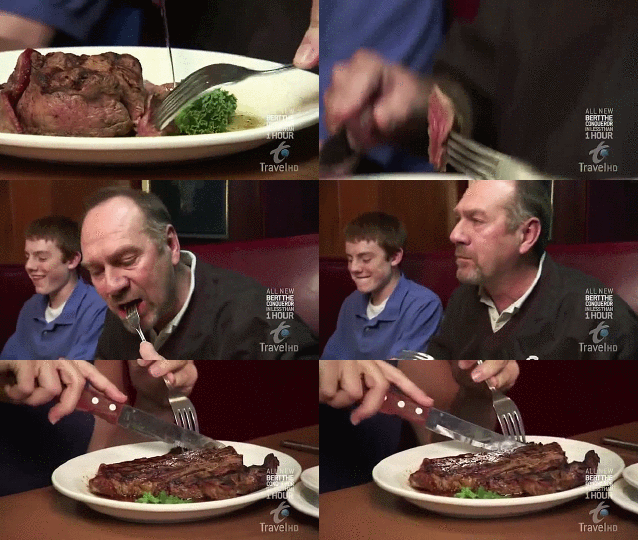
Last Monday (4/13), I slipped up. I woke up that morning, grind-ed up my coffee beans, french pressed my coffee, and made a hamburger. I am one of those weird individuals that really enjoys dinner for breakfast. I will always eat my leftovers from the night before. But on a high-note, I didn’t eat any other meat after breakfast.

Yesterday (4/21), I slipped up once again. I didn’t eat a hamburger for breakfast, or even for lunch. But I did eat taco’s with ground beef for lunch.

I swear I am going to get better at this. Since I have lot’s of dietary restrictions to begin with (deathly allergic to wheat, milk, chicken, and seafood) it’s really hard to cut one more thing out of my diet. I know that I am making excuses, and it’s only one day out of the week. I am determined that I will be able to do meatless-Mondays.

SteakGettingCutUp

My house recently updated their smoothie-blender and this will be a great way for my to obtain some extra protein. The protein powder that I currently use is Vega-Sport and is completely vegan (it cost an arm and a leg though!). If Vega-Sport could sponsor me for weight lifting send me free jug’s of protein powder, I would be greatly appreciative. HMU Vega-Sport.

On a brighter note, I have biked to the gym every single time. I actually saw Russell when I was trekking up the High Street hill by the gym, and he yelled from a distance, “BURN THAT CARBON CODY!!!”. So there is actual proof that I have been fulfilling that goal. Overall, Biking to the gym is a great warm-up for my work-out and reduces my overall footprint.

The James Bond showers are more like half James Bond, half Cody Hulsey showers at the moment. They aren’t completely James Bond yet, but they are getting there. I am confident that I will have achieved full-James Bond within the next few days. It’s pretty hard to jump into a freezing cold shower when you have just woken up.

Like I stated earlier, change is hard. But I am a determined human-being that is willing to sacrifice some of my guilty pleasures for the overall greater good of society. I welcome you to subscribe to my blog post, and keep up to date with what’s going on in the marketing world and how my ecological foot-print is going.

2pacPeace

Ecological Footprint Update: 1/2 James Bond, 1/2 Cody Hulsey

Maine Students Disembark to Denmark

This past week, I read an interesting article about a company by the name of Vestas, that specializes in wind turbines. The article talked about how they practice sustainability marketing because they aim at maintaining long-lasting relationships with both its customers and the natural environment. Whereas green marketing tends to centralizes around the idea of solving environmental problems and the reduction of the environmental burden.

The NY Times created an interesting news article about a group of people from Maine whom consisted of students and non-students that adventured over to Denmark to check out their Sustainability practices. The Island called Samsø has been known to have great success when it comes to energy self sufficiency using renewable sources. “In 2007, Samsø became 100-percent renewably powered and carbon negative through a combination of home efficiency and conversions to biomass, solar, and wind power.”

When these people first got to Samsø they were expecting some technical story around how they become so successful, but what they came to realize is that their success was because of their people.

Søren Hermansen owes a lot of credit for Samsø’s success. Hermansen had to persuade a somewhat-resistant agricultural community to take charge of their energy future. As you may know, persuading a resistant individual that sustainability marketing is the way to go, can be quite difficult.

“They used proven technology (now more than a decade old) and garnered widespread support by using a transparent and personal approach. They always began with the social, cultural, and economic returns of the project, rather than focusing solely on environmental implications that for some are less tangible.” BINGO, Samsø knows what they are doing. They are really flexing their sustainability marketing muscle and leaving a positive impact on our world.

While I was reading this article, I thought to myself, “That would be really cool if our professor took us to Samsø. It would be a great learning experience and an eye-opening opportunity”. ***Cough Mrs. Wilhelm Cough***

All in all, this was a very interesting article and makes you wonder what a difference you can make on the world if you approach businesses with a sustainability marketing approach instead of solely a green marketing approach. Until next time…

TheWolf

Maine Students Disembark to Denmark

NYC Sets Goal of Reducing Emissions by 80%

I like to consider myself a vet when it comes to this gluten-free craze. Since I was 3 years old I have been deathly allergic to wheat. During my sophomore year of college, I had my first beer. This might seem like a crazy thought but beer is loaded with gluten. But I was walking through Haggen and realized that they actually carry gluten-free beer. One beer in particular was Omission. This company uses reverse osmosis to extract all of the gluten out of beer. Anyways, I happily purchased this beer and took my first sip.

You might be thinking, “Why is he talking about gluten-free beer?”. Well, when I was scrolling through the Sustainable Development section of the New York Times, I scrolled across a very cool article titled, Building Toward a Goal of Reducing Emissions in New York City by 80 Percent. The word emissions actually made me think about the word Omission which in the end made me think about the first time I drank gluten-free beer. Anyways, isn’t that an eye-grabbing title for an article? I can see reducing emissions by 50% being extremely impressive but 80%!? That is downright mind-blowing.

MindBlownNeo

During the People’s Climate March in September, Mayor Bill de Blasio went out of the way to announce that he has a goal of reducing New York Cities greenhouse gas emissions 80% by 2050. That is nonetheless a hefty goal. Do you think its realistic? 25 years is quite sometime and a lot can happen in the evolution of sustainable practices.

Currently in my sustainability marketing class, we have been talking about ways to reduce our ecological footprint. New York City is a huge compact city and there is definitely a lot of pollution and trash (I witnessed it first-hand when I visited in high school). But I think that it is totally awesome that New York as a city is trying to reduce their footprint. Makes you wonder if Bill de Blasio had taken the ecological footprint quiz on myecologicalfootprint.org.

Interested

NYC plans to have cut their emissions 30% by 2030. Since 2007, the city has already been able to reduce their emissions by 19%. It sounds like they are one the right track! NYC was able to achieve this 19% reduction by mainly switching from coal and oil to natural gas for electricity generation.

NYC has one million buildings that emit a majority of these emissions. The main areas that emit emissions are from powering, heating and cooling of the buildings. They focus mainly on these areas to achieve the 80% emission reduction. They will also equip 24 public schools with solar panel roofs. Once these 24 have been implemented, they plan to equip 276 other schools with solar panel roofs.

These sustainability improvements will create a positive impact on the environment, as well as the wallets of NYC. New York City currently spends $800 million a year on energy costs, but when everything is set-up, they expect to save $180 million a year.

This a huge step in making our world a better place. When other cities see the success that NYC has achieved, they will not only be impressed but will jump on board to lower greenhouse gas emissions. Do you think that NYC will be able to achieve the 80% reduced emissions? Let me know in the comment section.

Waving

NYC Sets Goal of Reducing Emissions by 80%

Sustainable Marketing is the Now.

Today officially marks the second week of spring quarter. As you may know, my name is Cody Hulsey and I am senior at Western Washington University. I will be graduating this June with a degree in business administration with a concentration in marketing. I love music, fashion, and working-out.

A month ago, I was debating on what classes to take this quarter. I knew that I wanted to take a couple marketing classes and wind surfing (you gotta have some fun your last quarter of college). I was scrolling through the marketing classes that were going to be offered and then all of a sudden my eyes locked on Marketing Strategies for Sustainability. I was hesitant at first because I didn’t really have a strong opinion when it came to the topic of sustainability. My Step-Dad is a very environmentally conscious individual. I was constantly educated on the topic but for some reason I felt standoffish. Then I realized that the reason that I was standoffish was because global warming is a serious scary thing. As a marketer and individual who has grown throughout the years, I decided that I want to start getting serious about sustainability.

My first car in high school was a Volkswagen Jetta. Yeah, I know, this car is very popular among high school girls. But what made this car bad-ass, was the fact that this car ran on used vegetable oil. My MPG was something to brag about, if I remember correctly, it was around 45 MPG. It often made the car smell like french fries but it ultimately made a positive impact on the environment.

Recently I decided that I should see what my personal ecological foot-print was. MyFootPrint.org is a really cool website that offers a quiz to see how many planet earths we would need if everyone lived like you did. As I was doing the quiz, I often found myself having to really think about my recycling habits and how much meat I consume. When it got closer to the end of the quiz, I found myself thinking that I was not leaving the most positive impact on our earth. Especially when the quiz spit out the results.

If everyone were to live like me, we would need 5.51 earths (I felt very guilty as I was typing that out BTW). After completing this quiz, I decided that it was time to change some of my habits.

Screenshot (25)One area that I really need to improve on is my Food Footprint. I work-out a lot and with that said, I eat a lot. But that does not mean their is ways to eat more efficiently. Starting tomorrow, I will be participating in meatless Mondays. Not only will this be a hard change for me but it will make me feel better as a human being.

Screenshot (26)Another category that needs improvement is my Housing Footprint. Although it is not much higher than the country average, it still needs to be improved. To help reduce this footprint, I plan on taking James Bond showers Monday through Friday. James Bond showers are essentially cold showers. When you use hot water in the shower, it is using energy. I believe that this will cause a decrease in my Housing Footprint.

Like I stated earlier, I really enjoy working out. I thought for quite sometime on how I can incorporate this into my sustainable practices. Then it dawned on me. I realized that I often find myself driving to the gym (especially if it’s after 4:30PM). Instead, I decided that I am going to start riding my mountain bike to the gym. This will allow me to cut-back on carbon emissions and get a nice warm-up before my workout.

Every week I will keep you updated on how my sustainable practices are going. I hope the my sustainable journey will inspire you to take on sustainable practices. Make sure to subscribe to my blog posts to stay current with what is going on.

Sustainable Marketing is the Now.