What I Can Do For You As Your Digital Marketer

Winter quarter is coming to an end *sheds a single tear that is infused with joy and disappointment*. I will graduating in June with a degree in business administration with a concentration in marketing. These past four years have been a journey consisting of the typical peaks and valleys; with some slogging through mud in between them. I have confirmed that college is a great experience in that it really allowed me to figure out who I am and what career path I want to take. When I first entered into Western Washington University, I only had a vague idea of what I wanted to do. I knew that I wanted to go into business, and when family members, colleagues, and others would ask what I was pursuing, I would say something along the lines of, ” I know that I want to go into business but am unsure of what part of business to concentrate on.”

Then it dawned on me. I am MADE for marketing and I have been doing it since I was in 6th grade. For example, my brother and I were pretty bummed out that our middle school stopped selling candy, so we decided that we would take the opportunity to do what any marketer would do; fulfill the needs of customers. We purchased Skittles in bulk from the local Cash-n-Carry, and then we sold them for a dollar each. I remember getting a rush after each sale (it could have possibly been a sugar rush) although unfortunately we consumed most of our profits so it failed to become the candy empire I had envisioned.

Later on in high school, I started selling high-end clothing and Air Jordan’s through my website www.somefire.com, with the business model of buy-low and sell-high. This was very profitable until people realized that there was little barriers to entry. Soon I was surrounded by competitors from my school, so I decided to use my entrepreneurial spirit to go down a different lane. During my sophomore year of college, I created my own clothing brand called SomeFire, and stepped away from the (now saturated) luxury used clothing market that I had used to love. This custom clothing design experience strengthened my marketer’s mindset. So far I have designed (with the help of my good friend Bobby Davis) three different collections which range from t-shirts, long-sleeve t-shirts, tank-tops, and hoodies. I will be releasing my next collection within the next month.

IMG_6470

In January, I participated in the Student Marketing Associations XMC Case Competition with two other colleagues of mine. We met on a rainy Saturday morning at 8AM, we were given an Ivy business case and were asked to build a presentation, recommend what the business should do, and present it after 4 hours. We competed against 11 other teams, and placed first through an emphasis that I can only characterize as ‘unbounded creativity’ . Creativity is usually hindered when under-pressure, but we were able to work as a team to come up with a creative and realistic set of ideas to compete with an elite set of teams who we know would be going ‘by the book’ with their recommendations.

These past three months have been an excellent learning experience. I had the honor of taking a digital marketing class that expanded my digital marketing skills, and this single class has morphed me into a full-stack smarketer (smart-marketer). Within the last three months, I have become certified in Google Analytics, Hubspot Inbound Marketing, Hootsuite Social Media Management, and Google AdWords.

To obtain these certifications I needed to demonstrate to have an in depth knowledge on the topics. I have spent countless hours these past three months studying, blogging, reading, and learning about topics such as:

This quarter, hands-down, has been my best learning experience thus far in college. The list that you have just read (which include direct links to each topic that I blogged about) shows topics that we were assigned. With these topics, I was asked to not just read an article, but to know like it the back of my hand.

What I can do for you as your digital marketer? Well, a TON really. I am seeking a career in consulting, marketing, or as a marketing consultant and whichever of these directions I end up going, will bring digital marketing knowledge with me. I have gained a relatively vast base of knowledge when it comes to social media, content marketing, analytics, search engine marketing, and other digital marketing disciplines. I will also be participating in a project management crash course after this quarter which eventually will lead to a certification as a project management professional. I am an entrepreneur that loves solving problems, and coming up with great ideas. I have excellent communication skills, and I love working in teams. While being a full-time student at Western Washington University, I also engaged in internships and part-time work at companies such as Nordstroms, Hertz, and Bellingham Marine Industries. As your marketing consultant I will use the knowledge and skills that I have acquired over the past ten years to drive a positive impact for your company.

Throughout this quarter our class had to blog twice a week. Within the last three months, I have typed 22,473 words, and have had 475 views.
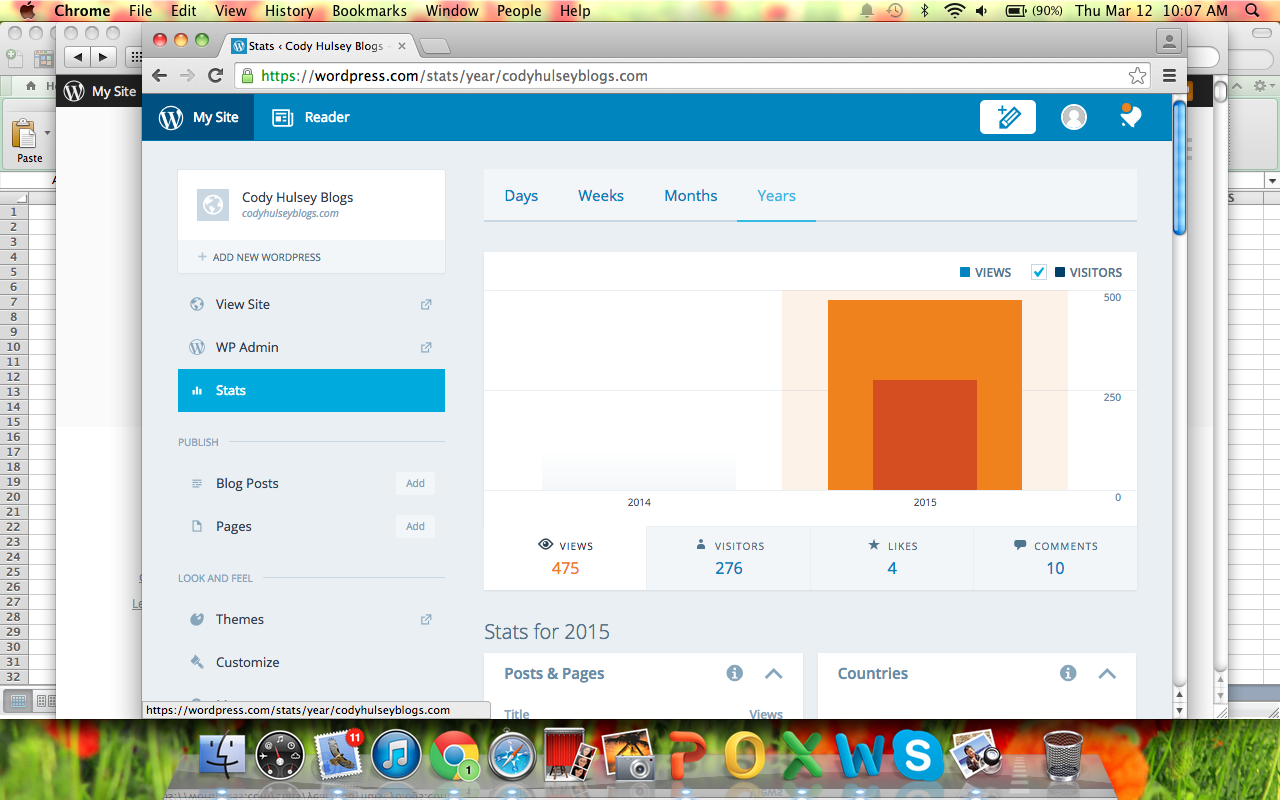
Screen shot 2015-03-12 at 10.07.51 AMI plan to continue to blog every week, but it could get tough when it starts to get nice out, and my final quarter at WWU starts. Until next time fellow smarketer…


What I Can Do For You As Your Digital Marketer

What’s The Point of Google Analytics?

Kid Cudi dropped a song a couple days ago titled, Love. It is actually a really great song, and I love it (see what I did there). This could be the first single off of his Man on The Moon III album, which is supposed to drop this year (Praying emoji). Give it a listen below. It is very uplifting, and makes you, well, happy.

https://soundcloud.com/cudderland/love

You might be thinking, “What does this have to do with Google Analytics, Cody Hulsey!?!?!”. Well fellow reader, I love the analytic’s side of digital marketing. Google is the big homie when it comes to analytics. They decided to go out of their way to create a certification course called Google Analytic IQ Certification. They also went out of their way to get you prepped for the certification by providing you with the Google Analytics Platform Principles. I am going to talk about a few of the most interesting things that I learned while watching the informational clips.

When you use Google Analytics you can collect and analyze data across a variety of devices and digital environments. Companies use Google Analytics to understand what their customers find and interact with when it comes to websites and mobile apps, but Analytics can be used to measure behavior on other devices like kiosks, point-of-sale systems, game consoles, and even appliance.

There are four components of the Google Analytics platform:

  1. Collection – this component is centered around the idea of collecting data, To successfully collect the data from your customers, you must paste the code on every page of your website that you would like to track.
  2. Configuration – you can configure Google Analytics to import data directly into your reports from other Google products, like Google AdWords, Google AdSense, and Google Webmaster Tools. You can also set filters that allow you to remove any data from your own employees (once a filter is set, you will not be able to see your employee’s data again).
  3. Processing – in this stage, Google Analytics transforms the raw data from collection using the settings in your Google Analytics account.
  4. Reporting – once Google Analytics is done processing, you can view the results of the findings on the reporting interface.

On the reporting page you will see that there is a data model. There are three components to the data model that are crucial to know about:

  • User:  a visitor to your website or app.
  • Session: the time they spend there.
  • Interaction: what they do while they’re on there.

I am going to paint a picture for you because I like coming up with stories. Also because people tend to retain knowledge and feel more connected when they hear a story.

Now close your eyes (not actually because you have to read this). Picture you are the owner of a small high-end fashion boutique. You have lot’s of customers, some who come in and look around at a particular pair of Raf Simons shoes, some that look at a Dries Van Noten Jacket, and some that purchase a Alexander Wang bomber jacket. You also have the customers that come in and ask if you have the most recent collection of the I Love Ugly S/S 15 menswear. When you tell them that you don’t carry that brand, they immediately leave. Think of each of those real life interactions in the same way when thinking about Analytics. You might have 5 interactions with a customer, or you might only have one (the I Love Ugly customer). Then however long a customer was in the store, is their session time.

So how does tracking work? 

Google Analytics uses tracking code to collect all of that precious data. The information that is collected, is shipped off to the Analytics servers via an image request. This image request is considered a “hit”, and it is the Maserati that speeds as fast as possible to Google Analytics.

Maserati

<!– Google Analytics –>

<script>

(function(i,s,o,g,r,a,m){i[GoogleAnalyticsObject]=r;i[r]=i[r]||function(){

(i[r].q=i[r].q||[]).push(arguments)},i[r].l=1*new Date();a=s.createElement(o),

m=s.getElementsByTagName(o)[0];a.async=1;a.src=g;m.parentNode.insertBefore(a,m)

})(window,document,script,//www.google-analytics.com/analytics.js,ga);

ga(create, UA-12345-6, auto);

ga(send, pageview);

</script>

<!– End Google Analytics →

In the above code you will see 10 characters that are bolded. This is the tracking code. A lot of websites will ask for you to paste the simplified tracking code and not the whole entire JavaScript text. Simply go into your Google Analytics settings to obtain this tracking code. There is different tracking codes out there. There is tracking code to create hits for websites and then there is tracking code for mobile apps.

Mobile apps don’t use traditional JavaScript code, they use SDKs (Software Development Kit). There are different SDKs out there, it all depends on the operating system i.e. iOS, Android, and etc. These mobile apps have a different way of dispatching as well. Data from mobile apps is not sent out immediately. Instead is stores the data, and then when there is connection to the internet, it’s sent over. SDKs dispatch hits every 30 minutes. So don’t freak out if it doesn’t look like your data is being recorded.

AmericanPsycho

I hope you have came to a better understanding on what Google Analytics is, and what you can do with it. Google Analytics allows you to understand the actions of your customer whether they are on a website, mobile app, kiosk, appliance, or much more. When you realize customers are not viewing certain pages, you can use your creative skills to direct them to that neglected page, possibly with A/B testing? Until next time fellow smarketer…

DogWind

What’s The Point of Google Analytics?

Is Mobile Marketing Really Going to Last?

Isn’t it the worst when you are linked to a website, or you go to visit a website that you looked up through some sort of search engine, and then when you get there, it sucks. When I say it sucks, I am talking about when you can’t press on links, maybe you have to scroll to right or left to see what an image is, or the text is tiny. All in all, it sucks, its frustrating, and it makes you think poorly of that business. Like, why have they not gotten with the times and created a website that is mobile-device friendly?

If you are still confused on what I am talking about. Well, view the photo below.

The photo on the left is what you would ideally see on a regular desktop computer, but it is just plain annoying when you have to view it through a cellphone. You want your website to be mobile-device friendly, like the one on the right.

Those informative folks over at ComScore have created a beautiful white paper titled, U.S. Digital Future in Focus 2014. I would be lying if I said that this white paper was useless, because it is damn informative and eye-opening. Multi-platform users (people who use both mobile and desktop devices) are becoming more and more popular. Did you know that at the end of 2013 56% of digital media consumers constituted the ‘multi-platfom majority’? Yeah, I didn’t know that either.

Thinking

Since this is becoming more and more prominent, marketers need to tighten their boots and jump feet first into being able to market to multi-platform users. In all actuality, Instead of surfing the wave, you will become the wave. You will be able to tell your competitors that you been on that mobile marketing tip.

You have to be able to tailor each message depending on if they are on a mobile device, or on their desktop. This partially goes back to what I was talking about in the beginning of this blog post. Based on what they are doing on their mobile device, you can target certain advertisements, certain offers, and much more. As a marketer, you must get as creative as possible.

In December of 2010, smartphone engagement has grown from 131 billion total minutes spent on the platform to 442 billion by December 2013. Mobile accounts for 57% of all internet use. Smartphones have passed desktop usage. That’s insane, technology is changing too fast man. ***MIND BLOWN*** Now do you believe that mobile marketing is only going to become more and more popular?

In 2013, 85% of internet time spent on smartphones involved apps. People love their apps. Marketers should be aware of this (hopefully they already are tbh) because it could be a great way for them to enter into markets that is not typically the norm.

Starbucks is the king when it comes to getting you addicted to their products. Starbucks recently created an app that allows you to make purchases through your phone. Washington Post actually wrote an article titled, Starbucks Has Managed to Get You Addicted to Its Coffee – And Its App. Starbucks announced that customers pay for a purchase using a smartphone up to 7 million times per week. Out of all the transactions that Starbucks accumulates, 16% of those are mobile payments.

Starbucks

Starbucks is killin’ it right now. They have also implemented their My Starbucks Rewards program, which allows their members to earn special discounts and free shwag. They also give you a free coffee when it’s your birthday. Except they’re sometimes a couple weeks off (this happened to my digital marketing professor), better late than never, right?

Another cool thing is that they are able to decrease the amount of credit card transaction which means less credit card fees on their end. Starbucks is about to make a killing. BRB about to go invest in Starbucks stocks. Fun fact, since December 23rd their stocks have jumped up ~$12. Not too shabby Starbucks, not too shabby.

Starbucks is ambitious which is probably a huge component of their success.In 2015, they plan on allowing you to place orders from your phone. This will decrease wait times, and potentially raise sales. BRB about to actually go invest in their stocks.

ComScore created ANOTHER dope white paper titled, The U.S. Mobile App Report. Let’s say that every 8 minutes that you are on your cellphone, 7 of those minutes involve an app. People love their apps. If businesses really want to connect with their target audience, they should create an app they can view their website, products, or offers. I frequently view Four-Pins.com, which is IMO one of the dopest fashion, life, style, gear blogs on the internet. Like check out this recent post by them. Do you love Raf, but hate the price? Because I do. I would purchase tons of Raf Simons if I could afford it. When I land my first job, you better believe that I am going to be Raf’d out (hopefully, student loans could prevent that for awhile). If they had an app, they could potentially get a lot more views/ viewers. It’s always so much easier pulling up an app, than having to go through a search engine to go to a website. (wow, technology has made me sound very lazy -___- ) Creating an app could take some foot-work on their end, but I think they would benefit greatly.


Damn, if that’s not #fire, IDK what is. Look at that fish-tail. Look at that attention to detail. #Wheww #Wheww #Wheww.

So let’s say that you are reading this blog post because you want to improve you site. Well, Moz created an article titled, The SEO’s Guide to Building a Great Mobile Site. When you are trying to decide on how to make your site, mobile-friendly, you need to think about the content. There is two options for content, you either have the same content that is on your site, or different content. Before you worry about the technology aspect, you need to understand what you goals are with the mobile site. Do you want to simply inform them about directions to your restaurant? Possibly only list your hours? Maybe all the information that your regular site provides is a little excessive and needs to be trimmed down. This step may seem miniscule, but it is a huge component.

Once you have decided the content-side of the mobile website, you can dig into the technology side. The easiest way and most time efficient option in the long-run would be to create a responsive site. This is an identical site, but it works better with mobile devices.

Mobile search is the future. It has surpassed desktop search, and is going to continue to place desktop’s in the future. At this rate, desktop’s will probably not even exist in 10 years (actually I bet you $100 there will be some type of projection that comes off your mobile device, and whenever you need to see something bigger, or work on something, you simply project it onto your wall. IDK just thinking out loud). Until next time fellow smarketer…

JAY

“Blog so hard, got a broke clock, rolleys that don’t tick-tock” – Jay-Z (pretty sure he said that once, could be wrong.)

Is Mobile Marketing Really Going to Last?